Beachcombing
Beachcombing Texada
(Based on a story told me by my father, Lee Roberts)
By Tad Roberts
Beachcombing in BC is a very specific enterprise; the practice of cruising the local coastline in a small boat and recovering usable or marketable logs that have escaped their original owner’s care and floated free to wash ashore on some distant and unknown beach. In the past century the temperate rain forest which covers the BC coast supplied what was once seen as an endless supply of softwood logs for a growing world. And in a mostly vertical landscape water transport was the obvious choice to move these logs from the isolated hillsides where they grew to the big mills in population centres. Once dumped in salt water logs were organized for transport into simple rafts called “booms” and towed at very low speed, with the help of wind and current, to market. Along the way some, or sometimes many, of these logs would escape the boom and be deposited by the tide on some isolated beach.
In a land of plenty this small percentage loss was mostly seen as part of the cost of transport and there was little concern for where these logs ended up. This “free” timber, available for the taking, was a boon to subsistence farmers and fishermen who lived along the coast. The worst quality wood became firewood to heat the house or boat, but much of the better stuff was used in buildings, boats, docks, and all the small structures that made coastal homesteads. And some of it supplied small local mills to be sawn for lumber sales.
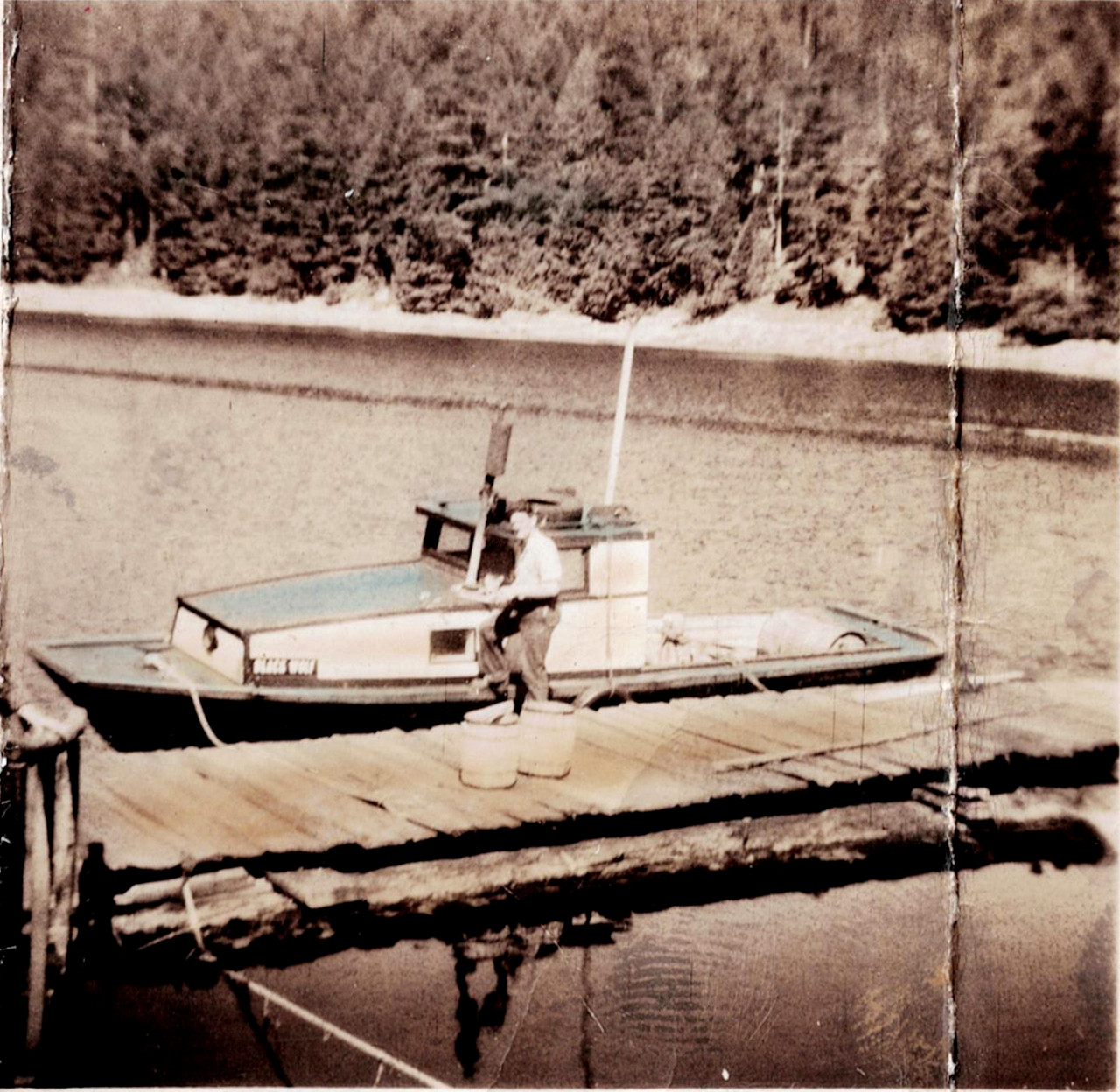
In the 1930’s, ’40’s, and ’50’s my father Lee Roberts lived with his father (Harry Roberts) and sisters on the beach at Cape Cockburn on Nelson Island. The key to independence in a land with no roads was a boat of your own, and there was no money to buy a boat so it must be built, and there was no money to buy lumber, so logs were beachcombed and sawn into lumber with their own small mill in front of the house. Lee was about 16 years old in 1951 when he launched his own first boat, the Black Wolf, a 28′ beachcomber. The boat was small, with a square nose and shallow draft, and strongly constructed for working around a beach. Her original power was a two-cylinder Easthope gas engine, slow-speed and 15-20 horsepower, this was later replaced with a flat-head Ford gas engine of maybe 65 horsepower.
Directly to the southwest of Cape Cockburn, four miles across Malaspina Strait, is Texada Island. This Malaspina side of Texada presents 25 miles of unprotected beach line where no one lives because there is no shelter or safe harbour. It’s a wonderful Shangri-la for beachcombing but a terrible place to be caught when the weather changes suddenly or night comes on. I know this beach line because my dad and I went back there and beachcombed Texada in the 1970’s with a bigger and more powerful tug, but this story takes place in the early 1950’s.
My Dad left Cockburn Bay early, alone in his little boat the Black Wolf. Running straight across to the Texada shoreline took about an hour and there was lots of wood on the beach, so he picked up a half-dozen logs quickly. Running the bow in onto the beach, jumping ashore with the towline, hooking it around a log he thought he could pull, then backing the boat out, turning around, and jerking on the towline until the log was afloat. Then gathering all the logs together and towing them down the beach to the next likely selection, there dropping those already recovered to leave them adrift, and going through the beach pulling exercise once again.
It was after mid-day and the tide was running strongly parallel to the beach, so the boat ended up backing out over a very different course than she came in on, this can be a bit critical. Backing out a bit too quickly so as not to get messed up in the tide, bang and thump and the engine stops dead. He’d hit an offshore rock ledge that the boat got behind in the current. Get the anchor overboard now before we’re back on the beach sideways. Feeling around underwater over the stern he could tell the propeller and shaft were bent and the prop had jammed against the hull and none of it would turn. Home and safe harbour are six miles away, the day is getting on, there was no radio to call for help, and it might be days before a passing boat came close enough to attract with waving arms.
If he could get the shaft to turn it would move the boat, even all bent up he could just run at idle and get home eventually. The bent shaft meant the propeller needed more clearance, and the shaft line ran aft at an angle so moving the propeller further aft should allow it to turn. It can’t go far before the prop will get up against the rudder and jamb there, but maybe there’s enough room. He got busy, disconnected the shaft coupling from the engine and pried the shaft aft until…wonderful…it turned through 360 degrees freely. But how to fill this new space and re-connect the shaft to the engine? Thankfully there was a long enough piece of galvanized water pipe on the boat, trimmed to length with a hacksaw and jammed over the two shaft ends, the pipe made a temporary extended coupling that could turn the prop at idle.
And so, he idled slowly home, with nothing to show for a long day but another experience (take more tools next time) and eventual repair bill. He put the boat on the tidal grid in the cove, pulled the shaft and prop, and caught a ride on another boat to the machine shop in Pender Harbour. A few days later the Black Wolf was again operational, and Dad went back to Texada and found those logs again, this time successfully towing them home.
-
External Links
- Sorry, no links have been posted